The Future of Web Development in 2026
Explore the biggest trends reshaping web development in 2026, from AI-assisted coding and edge computing to WebAssembly and composable architecture.

Web development in 2026 looks nothing like it did five years ago. The tools are smarter, the infrastructure is faster, and the expectations from end users are higher than ever. If your stack or workflow hasn't evolved, you're already behind. Here's a clear-eyed look at what's shaping the industry this year, and what you should be thinking about.
AI Is Now Part of the Development Stack
AI has crossed the threshold from novelty to necessity. In 2026, AI isn't just a code autocomplete tool, it's embedded in design systems, component generation, automated testing, accessibility auditing, and even architecture decisions.
Tools like GitHub Copilot, Cursor, and Vercel's v0 now handle routine scaffolding so developers can focus on logic and architecture. This doesn't mean developers are being replaced, quite the opposite. The developer who can direct AI effectively, review its output critically, and compose systems from AI-generated pieces is extraordinarily productive.
What This Means for Teams
Junior developers are getting a significant productivity boost. Mid and senior developers are shifting toward architecture and review roles. Teams that have embraced AI tooling consistently outship those that haven't. If your workflow hasn't incorporated AI-assisted code generation and review, it's worth experimenting today.
Edge Deployment Is the New Baseline
Deploying to a single origin server in Virginia is no longer acceptable for a global product. Edge computing means running your code at dozens of geographic locations simultaneously. A user in Singapore doesn't route to the US and back, they hit a Singapore edge node with a 5–10ms round trip.
Platforms like Cloudflare Workers, Vercel Edge Functions, and Deno Deploy have made this accessible without complex DevOps. In Next.js, opting in is as simple as:
// app/api/fast-route/route.ts
export const runtime = "edge";

export async function GET(request: Request) {
  const data = await fetchNearestDatabase(request.geo?.country);
  return Response.json(data);
}
The result: sub-50ms Time to First Byte globally, better SEO scores, and dramatically improved user experience for international audiences.
Use Cases Where Edge Wins
- Personalisation at scale: A/B testing, geo-targeting, and user-specific rendering at the CDN layer
- Authentication middleware: Validate JWTs before any origin request reaches your server
- API proxying: Route and transform requests without additional latency
WebAssembly Is Moving Into Production
WebAssembly (Wasm) is no longer a research curiosity. In 2026, production applications are using it for image processing, video transcoding, PDF generation, cryptography, and real-time data compression, all in the browser, with near-native performance.
The rise of WASI (WebAssembly System Interface) also means Wasm is competing seriously with containers on the server side. Running a Wasm module as a serverless function cold-starts in microseconds versus the hundreds of milliseconds of a Lambda cold start.
Key Wasm projects worth watching:
- Fermyon Spin: serverless Wasm applications
- Extism: a plugin system based on Wasm
- Pyodide: Python running in the browser via Wasm
React Server Components and the End of "Fetch Waterfalls"
React's Server Components model, now stable and widely adopted in Next.js 14+, fundamentally changed how we think about data fetching. Instead of cascading client-side fetches, you co-locate data fetching with the component that needs it on the server.
// This component fetches its own data on the server, no prop drilling, no useEffect
async function ProductDetails({ id }: { id: string }) {
  const product = await db.product.findUnique({ where: { id } });

  return (
    <div>
      <h2>{product.name}</h2>
      <p>{product.description}</p>
    </div>
  );
}
This eliminates the "loading spinner inside loading spinner inside loading spinner" problem that plagued client-heavy SPAs. The result is faster perceived performance and dramatically simpler data flow.
The Rise of Composable Architecture
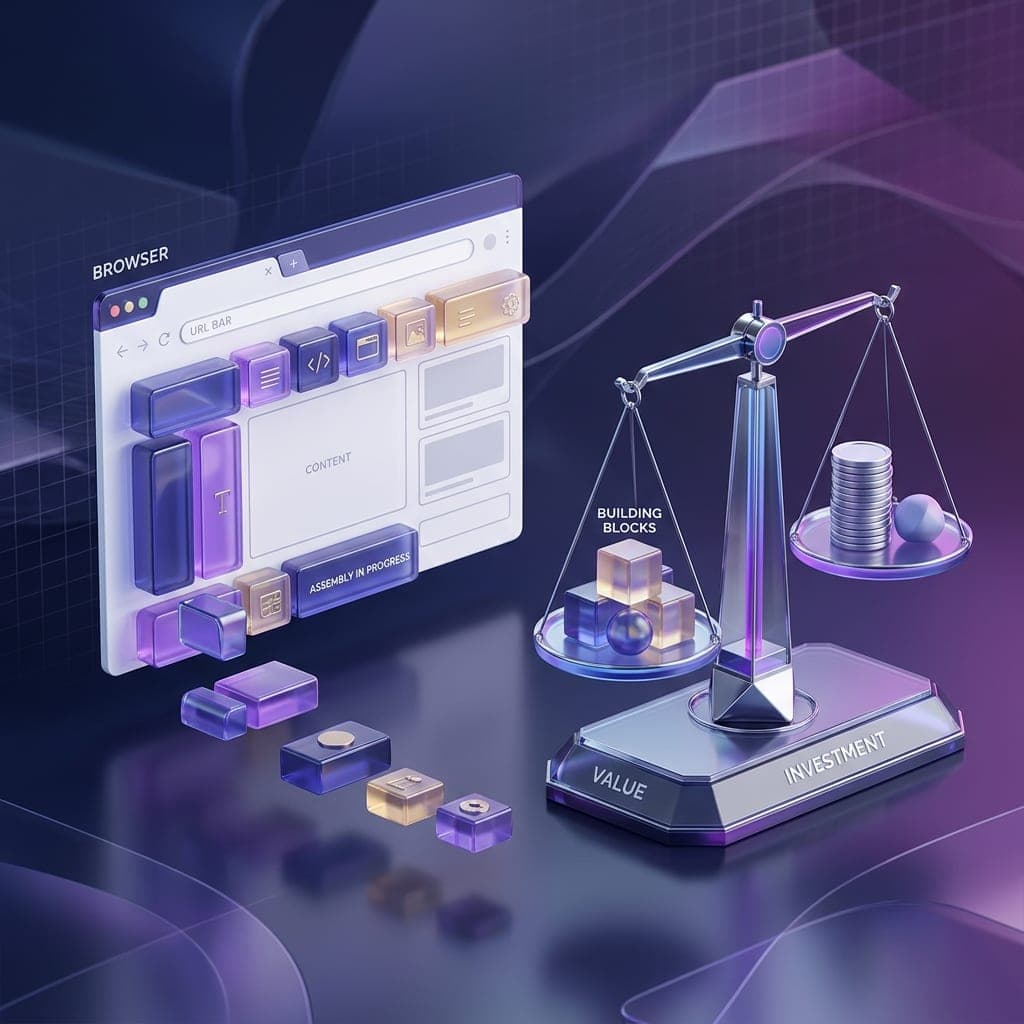
Monolithic frontends are losing ground to composable architectures systems built from independent, interchangeable pieces. A modern e-commerce frontend might use:
- A headless CMS (Contentful, Sanity) for content
- A dedicated search service (Algolia, Typesense) for search
- A specialised e-commerce engine (Shopify, Medusa) for cart and checkout
- A design system from your own component library
Each piece is best in class, independently deployable, and replaceable without affecting the others. The glue layer is a Next.js or similar meta-framework that orchestrates them.
This "MACH" architecture (Microservices, API first, Cloud native, Headless) is now the default for serious e-commerce and content platforms. If you're building at scale, composable architecture in your web development approach should be your starting point.
TypeScript Adoption Is Now Near Universal
TypeScript is no longer a preference, it's an expectation. New projects starting in vanilla JavaScript in 2026 are the exception. Type safety, improved IDE tooling, self-documenting code, and safer refactoring at scale make TypeScript adoption a productivity investment that pays back quickly.
The Next.js, Remix, and Astro ecosystems are all TypeScript first. The ecosystem of type definitions for third-party libraries (DefinitelyTyped) is more complete than ever. Onboarding TypeScript mid-project is painful; starting with it costs almost nothing.
Core Web Vitals Are a Hard Requirement
Google's ranking signals now weight LCP, CLS, and INP heavily. A site with poor Core Web Vitals is fighting the algorithm in every competitive keyword battle. In 2026, performance is not an optimisation you do later, it's an architectural constraint you design around from day one.
Key performance investments:
- Server rendering or static generation for above-the-fold content
priorityon hero images,sizesattribute on all responsive images- Dynamic imports for code that isn't needed at initial render
- Edge deployment for low TTFB globally
What to Do Right Now
The gap between teams that adapt and those that don't is widening. A few practical next steps:
- Experiment with edge functions for your latency-sensitive routes
- Migrate to TypeScript if you haven't already, the migration tooling is excellent
- Audit your Core Web Vitals with PageSpeed Insights or Lighthouse
- Evaluate AI coding tools (even a one-week trial reveals the productivity difference)
- Review your deployment architecture, are you serving global users from a single region?
If you want a partner to help modernise your web stack, Codolve's web development team works with these technologies in production every day.
Frequently Asked Questions
Is React still the right choice in 2026?
React remains the most widely used UI library, backed by Meta and a massive ecosystem. React Server Components have addressed many of the performance criticisms. However, competitors like Svelte and Solid are genuinely excellent choices for performance-sensitive applications. React is still the safest default for teams that need a large talent pool and ecosystem support.
Should I be learning AI/ML to stay relevant as a web developer?
You don't need to become an ML engineer, but understanding how to integrate AI APIs (OpenAI, Anthropic, Hugging Face) and how to use AI tools effectively in your workflow is increasingly important. The web developer's core skills, system design, component architecture, user experience, remain highly valuable.
Is Next.js still the best framework for building web applications?
Next.js remains the dominant React meta-framework, especially with App Router, Server Components, and excellent Vercel integration. Remix is a strong alternative with a different data fetching philosophy. Astro is excellent for content-heavy sites with minimal JavaScript. The "best" depends on your use case, but Next.js is a safe, well-supported choice for most applications.
What's the minimum performance budget I should aim for?
Target LCP under 2.5 seconds, CLS under 0.1, and INP under 200ms. These are Google's "Good" thresholds. Achieving all three in the "Good" range typically requires server rendering, optimised images, and minimal render-blocking JavaScript.
How important is TypeScript in 2026?
Essentially mandatory for production applications. TypeScript reduces runtime errors, improves IDE support, enables safer refactoring, and serves as living documentation. The investment to learn it is far outweighed by the reduction in bugs and debugging time.
Tags