Headless Commerce in 2026: A Practical Buyer's Guide
Headless commerce is no longer the obvious answer it was three years ago. Monoliths have caught up, costs have shifted, and the right call depends on specifics most pitches gloss over. Here's how to evaluate it for your business.
For five years, headless commerce was sold as the default future. Decouple the storefront from the backend, get unlimited frontend flexibility, ship anywhere. By 2026, the picture is more complicated. Shopify's monolithic experience has caught up significantly. Headless platforms have raised prices and added complexity. Some teams that went headless three years ago are quietly migrating back. Others are getting outsized results from custom storefronts that would have been impossible on a packaged solution. The right answer depends on specifics, and most pitches gloss over the tradeoffs. This guide is a practical framework for deciding whether headless makes sense for your business, what stack to choose if it does, and where the hidden costs live.
What Headless Commerce Actually Means in 2026
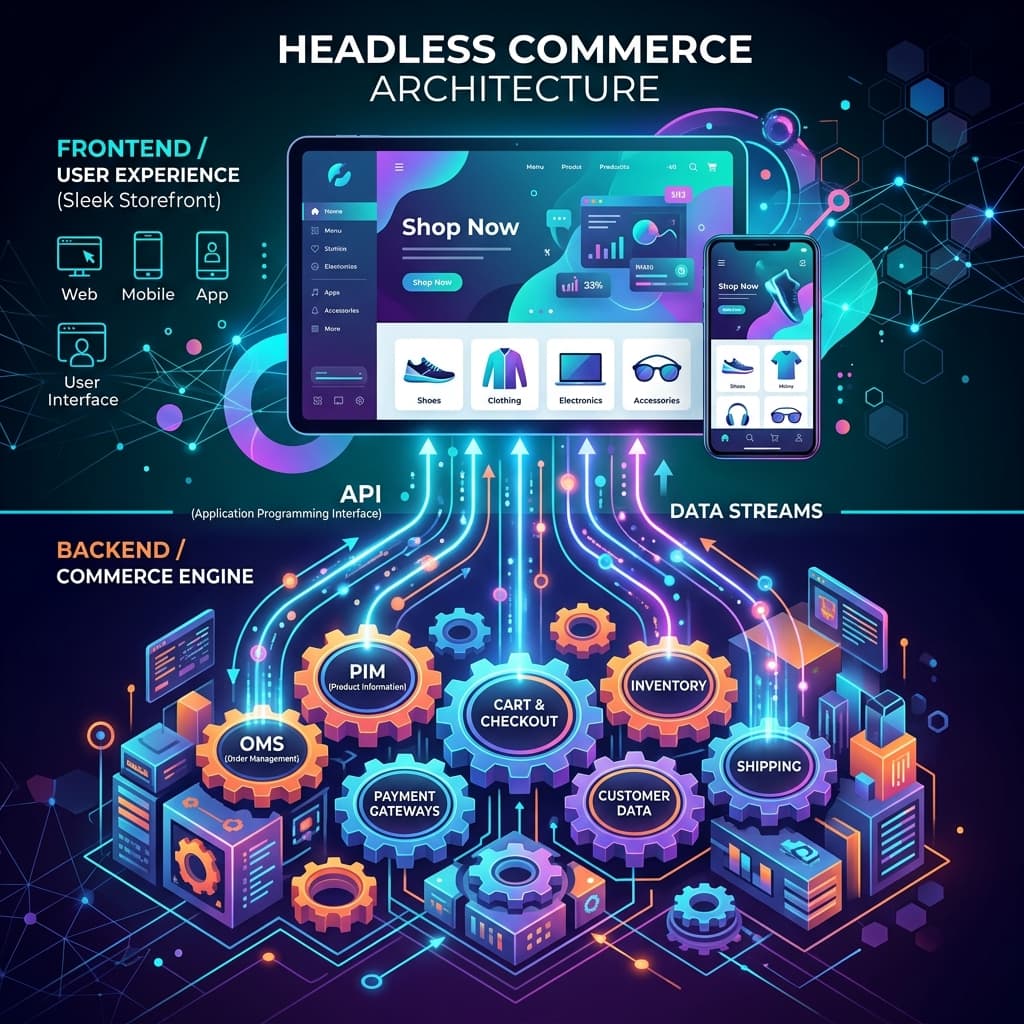
Headless commerce separates the storefront (what customers see and interact with) from the commerce engine (catalog, cart, checkout, orders, inventory). The two communicate over an API. The frontend is built however you want, typically with Next.js, Remix, Astro, or Nuxt, while the backend handles the commerce logic.
The promise is flexibility. You can build any frontend experience, optimize for any device, ship on any timeline, and never be constrained by template languages or platform quirks. You can also reuse the same commerce backend across web, mobile apps, in-store kiosks, and B2B portals.
The reality is that this flexibility costs something. You're now responsible for the entire frontend, including pages and flows that the monolithic platform gave you for free. Account management, password reset flows, order tracking pages, gift card redemption, store locator, search, all of these need to be built or wired into third-party providers.
The 2026 Stack Options
The market consolidated around a few clear architectures.
Shopify Hydrogen plus Oxygen. Shopify's first-party headless framework, built on Remix and deployed on their edge platform. Tightly integrated, well-documented, and designed specifically for Shopify backends. The tradeoff is lock-in to the Shopify ecosystem, which most Shopify merchants are fine with.
Commerce-specific headless platforms. BigCommerce, Commercetools, Elastic Path, and Centra. These were built API-first from day one. They tend to handle complex catalogs, B2B requirements, and multi-region commerce better than retrofitted monoliths. Pricing is enterprise-tier and starts around $30K to $100K per year.
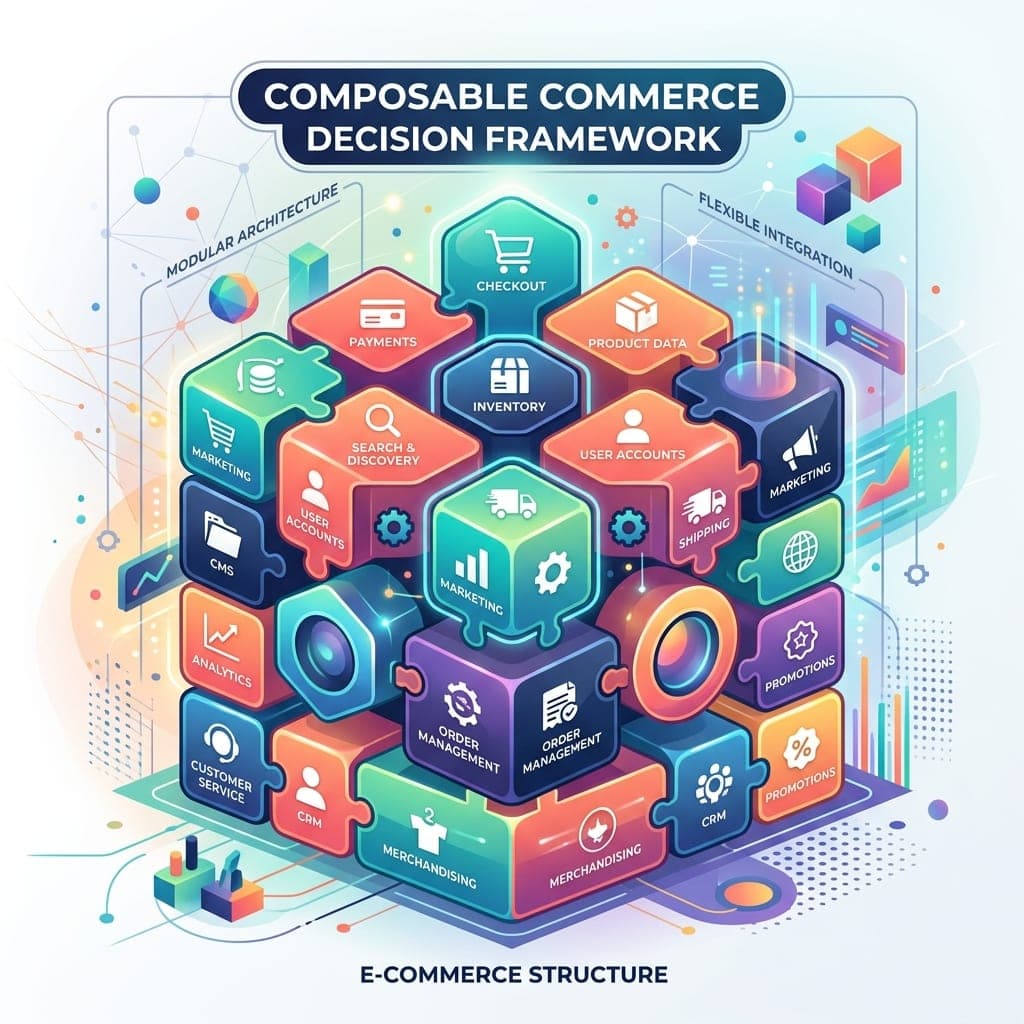
Composable commerce. Pick the best tool for each function. Stripe or Adyen for payments, Algolia for search, Sanity or Contentful for content, a thin commerce layer like Medusa or Saleor for orders. The maximum flexibility option, also the maximum integration burden.
Custom monolith. Build everything yourself on top of a database. Used to be common, increasingly rare except for very specific verticals (marketplaces, complex configurators, B2B workflows that don't fit packaged solutions).
The question is which of these fits your business, not which is theoretically best.
When Headless Makes Sense
Headless commerce is genuinely the right call when one or more of these applies:
Your frontend is your competitive differentiator. If your brand experience, content strategy, or UX is what wins customers, having full control over the storefront matters. A premium fashion brand whose competitor advantage is editorial-quality product storytelling cannot do that on a template-based platform.
You serve multiple channels with the same commerce. Web, mobile app, in-store, B2B, marketplace, all running off one source of truth. A headless backend lets you build different fronts without duplicating the logic.
Performance is mission-critical and the monolith can't deliver. For some product categories (high-traffic flash sales, content commerce, large catalogs), packaged platforms hit ceilings. A custom Next.js storefront with edge caching can be 3 to 10x faster than the same store on Magento or Salesforce Commerce Cloud.
You're integrating commerce into a non-commerce product. A SaaS product adding paid features, a media company adding a subscription product, a social platform adding marketplaces. The commerce layer is a component, not the core experience.
You have a meaningful engineering team. Headless requires real frontend engineers. Not "we have a developer who edits the theme sometimes," but a team that can own a frontend codebase, deploy it, monitor it, and respond to issues.
When Headless Is the Wrong Answer
A few signs that staying with a monolith is the better call:
You're under $5M in revenue. The engineering investment to do headless well rarely pays back at this scale. A well-configured Shopify or BigCommerce monolith ships features faster, costs less, and lets you focus on the business.
Your team is two people and an agency. Headless splits the surface area between commerce config and frontend code. Without engineers who can own both, the system rots quickly.
Your differentiation isn't the frontend. If you're selling commodity products on price, the storefront design rarely moves conversion enough to justify the engineering. A clean template-based store performs as well.
You need to launch in 8 weeks. Headless projects routinely take 4 to 6 months. Monoliths can launch in weeks. If speed to market is the constraint, take the monolith now and revisit later.
What the Pitches Skip
Three costs that consistently surprise teams going headless:
Pages you didn't realize the monolith gave you. Order history, password reset, address book, gift cards, loyalty redemption, store locator, FAQs, blog. On a monolith these come built-in or as one-click apps. Headless means building each one, or finding a third-party provider, or accepting that part of the experience.
Operational complexity. A monolithic store has one place to look when something breaks. A headless setup has the frontend deployment, the commerce backend, the search service, the CMS, the payment processor, the email service, and the analytics. Tracing a "customer can't check out" incident across that stack is significantly harder than on a monolith.
The team you need. A headless storefront needs at least one engineer permanently. If they leave, you need a replacement who can ramp on a custom codebase. The "we'll just hire an agency when we need changes" model works for monoliths and breaks for custom stacks.
The Composable Stack Sweet Spots
For teams that are headless-appropriate, certain combinations have emerged as 2026 standards:
Frontend. Next.js 15 is the dominant choice. Astro has carved out a niche for content-heavy commerce (where most of the site is editorial and only key pages are interactive). Remix continues with Shopify Hydrogen and a smaller independent following.
Commerce engine. Shopify Storefront API is the easiest to integrate and most cost-effective up to roughly $50M revenue. Commercetools and Elastic Path dominate enterprise B2B and complex catalogs. Medusa is the open-source option for teams that want full control.
Search. Algolia for SaaS simplicity, Typesense for self-hosted with the same DX, Meilisearch for content-heavy stores with fewer products. Native commerce platform search rarely matches dedicated providers.
Content. Sanity for editorial flexibility and developer experience, Contentful for enterprise governance and workflows, Storyblok for visual editing and marketing team comfort.
Personalization and recommendations. Klaviyo for email-driven personalization, Algolia or Constructor.io for on-site recommendations, in-house ML models for very large catalogs where general-purpose tools don't fit.
Analytics and monitoring. PostHog or Mixpanel for product analytics, Sentry for error tracking, Datadog or New Relic for backend monitoring, Plausible or Fathom for privacy-conscious traffic analytics.
Migration Planning: What Goes First
If you're migrating from a monolith to headless, the order matters. The pattern that works in practice:
- Build the new storefront alongside the existing one. Don't try to do a big-bang switch. Run the new site on a subdomain or a feature flag.
- Migrate the highest-impact page first. Usually the product detail page or the home page, where performance and conversion gains compound.
- Migrate the checkout last. Checkout is the highest-risk surface. Get everything else stable first.
- Keep the monolith authoritative for orders and inventory until checkout is migrated. This is non-negotiable. The commerce engine source of truth should not be in flux during the migration.
- Maintain feature parity, not feature expansion, during migration. Adding new features while migrating creates compounding bugs.
Realistic timelines: 4 to 8 months for a mid-sized store, 12+ months for enterprise. Anyone promising faster either has a very small surface area to cover or is underestimating.
Frequently Asked Questions
Is Shopify Hydrogen actually different from regular headless Shopify?
Hydrogen is Shopify's officially supported framework, built on Remix and deployed on their Oxygen edge platform. It's tightly integrated with the Storefront API and includes patterns, components, and hosting that just work. Building headless Shopify with Next.js or Nuxt is also fine, you just take on more of the integration yourself. For new Shopify headless projects, Hydrogen is the lower-effort option.
Can I do headless without rebuilding the checkout?
Yes. Most platforms let you use the native checkout while building a custom storefront for everything else. Shopify, BigCommerce, and Commercetools all support this pattern. You give up some checkout customization but avoid the highest-risk migration surface.
How much does a typical headless commerce stack cost per month?
For a mid-sized store: $500 to $2,000 for the commerce platform, $200 to $500 for search, $300 to $1,000 for the CMS, $100 to $500 for hosting, plus engineering time. Total subscription costs of $1,000 to $4,000 per month are typical before engineering. Compared to $300 to $2,000 for the equivalent monolithic plan, the platform cost is higher.
What's the actual performance difference?
Well-built headless stores routinely hit sub-1-second LCP on mobile. Equivalent monolithic stores often land at 2.5 to 4 seconds. For conversion-sensitive categories, this can mean 5 to 15% revenue lift. For commodity categories, the conversion difference is smaller.
How do I evaluate vendors objectively?
Ask three questions of every vendor. What does the migration path look like in 18 months when we want to switch? Show me three reference customers at our scale. What does the total cost look like in year three including platform fees, engineering, and integrations. Vague answers to these are red flags.
If you're evaluating a headless migration or planning a new commerce build, our team specializes in headless commerce architecture and implementation for production stores.
Tags