Money Nest
A personal finance management platform for users who want real clarity over their spending, savings, and financial goals

About the Project
Most people know they should track their finances. Almost none actually do, because every tool they try is either too complicated or too basic to be useful. Money Nest was built to sit in the middle: powerful enough to give real insight, simple enough that users actually open it every week. The design principle was zero friction. Adding a transaction takes three taps. Seeing your monthly summary takes one. Every feature exists because users needed it, not because it was technically impressive to build.
What We Were Solving
Most budget tracking tools are complex and overloaded with features, making them difficult for everyday users who just want to understand where their money is going. The client needed a simple but powerful personal finance system that allows tracking expenses, income, categories, and goals without unnecessary clutter.
The technical challenge was building a dashboard that updates instantly without full page reloads. Financial data changes constantly as users add transactions, and every chart, balance figure, and progress bar needed to reflect the latest state without the user having to refresh.
Data integrity was non negotiable in a financial application. Any bug that caused incorrect totals, duplicated transactions, or lost entries would immediately destroy user trust. The system needed robust validation, error handling, and data consistency guarantees from day one.
How We Tackled It
We began with user flow mapping, not feature lists. We identified the three things a user does most often in a finance app: add a transaction, check their balance, and review their month. Those three flows were made frictionless before anything else was built.
State management was chosen carefully. Zustand was selected over heavier options because the app needed fast, granular updates without the overhead of a full Redux setup. Each section of the dashboard subscribes only to the state it needs.
The chart library selection took time. We evaluated four options before selecting Recharts for its React integration, customisability, and performance with live data updates. Charts animate smoothly when new data arrives, which makes the app feel responsive and alive.
Security was implemented in layers. NextAuth handles authentication, all database queries are validated server side, and financial data is never exposed in client side state beyond what is needed for the current view.
What We Built
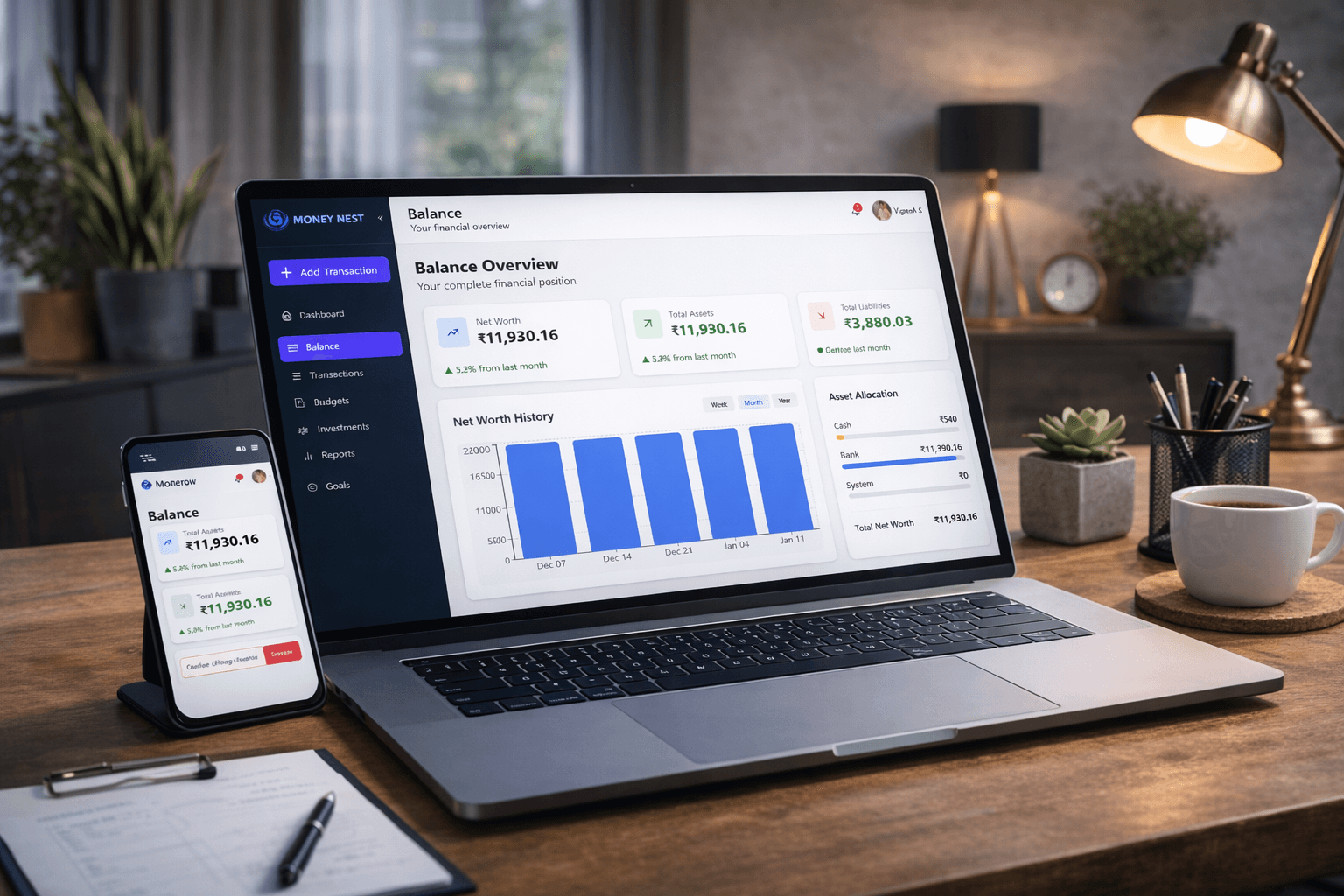
We developed Money Nest using the Next.js App Router for performance, smooth routing, and dynamic layouts. Zustand was implemented for lightweight and fast state management, ensuring instant UI updates across all dashboard sections. The architecture ensures that adding one transaction immediately reflects across balance, charts, and category summaries without any delay.
MongoDB stores all financial data with strict schema validation. NextAuth handles user authentication and session security. A fully responsive dashboard was built with Tailwind CSS, featuring interactive pie charts, goal progress bars, and monthly breakdowns that give users genuine insight into their financial habits.
Key Features Delivered
- Transaction tracking with categories, tags, and date filters
- Real time balance calculation across income and expense streams
- Monthly spending breakdown with interactive pie charts
- Savings goal tracking with visual progress bars
- Budget limits per category with over budget alerts
- Secure authentication with session management via NextAuth
- Fully responsive dashboard working across desktop, tablet, and mobile
- Fast state updates using Zustand without full page reloads
Project Screenshots