E-E-A-T in 2026: Building Content Authority Google Actually Trusts
Google's E-E-A-T framework is the closest thing to a public ranking blueprint we have. Most sites still treat it as marketing fluff. Here's what actually moves the needle, with the specific signals Google uses and the playbook to build them.
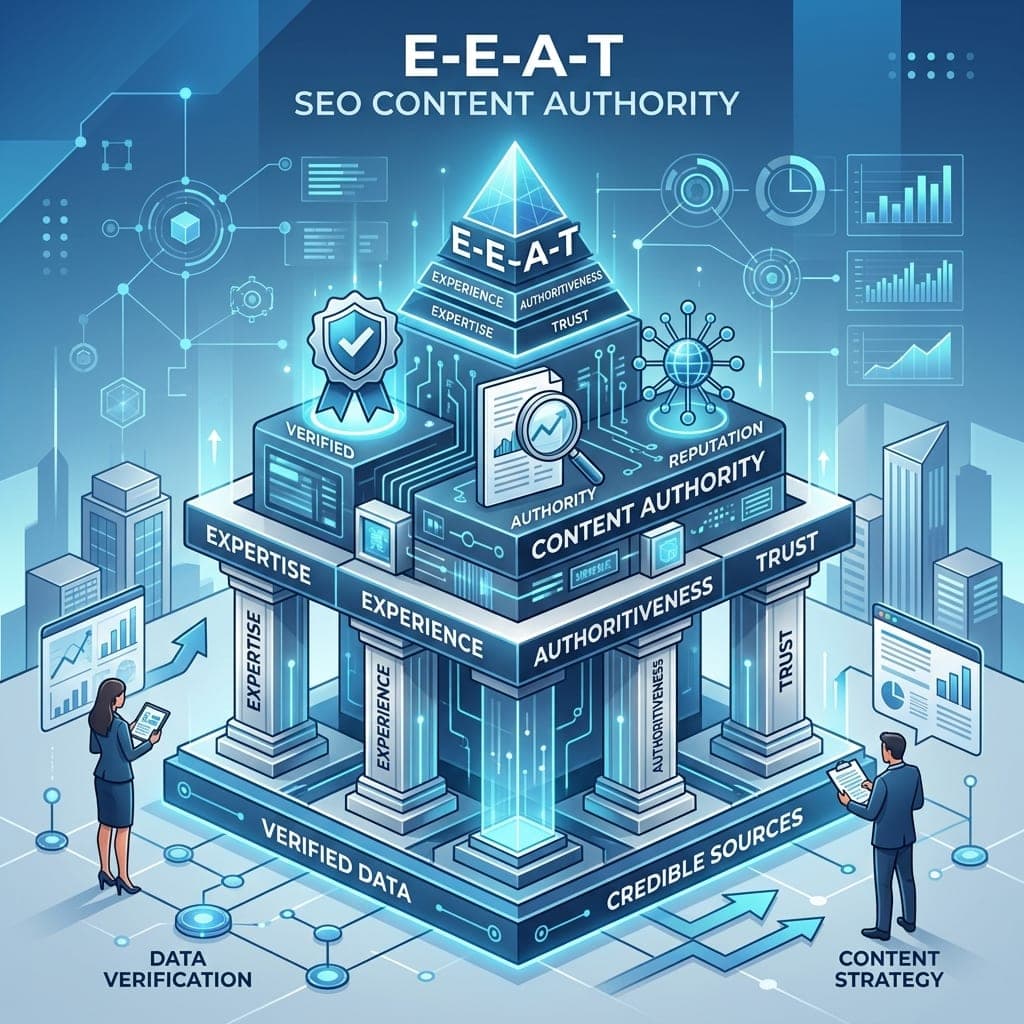
E-E-A-T (Experience, Expertise, Authoritativeness, Trustworthiness) is Google's framework for evaluating content quality and the closest thing to a public blueprint of how its algorithms judge content. Despite this, most teams treat E-E-A-T as marketing language to put on the about page rather than a set of concrete signals to build. The result is sites that produce volumes of content but never break through to the rankings their topical depth deserves. In 2026, after multiple "helpful content" updates and the rise of AI-generated content saturating every niche, E-E-A-T has become more important, not less. Google's algorithms have gotten significantly better at distinguishing genuine expertise from generic content, and the gap in performance between sites that demonstrate authority and those that don't has widened. This guide covers the specific signals that work, the patterns that don't, and the operational changes that actually shift how Google evaluates your content.
What E-E-A-T Actually Is
E-E-A-T originated in Google's Search Quality Rater Guidelines, the document Google gives the thousands of human raters who evaluate search results to train its algorithms. While the guidelines don't directly change rankings, the algorithms Google trains using rater feedback do reflect what raters are taught to look for. So while there's no "E-E-A-T score" being applied to your pages, the algorithmic signals trained against rater judgments approximate the same evaluation.
The four components:
Experience. Has the author actually used the product, visited the place, or done the thing? First-hand experience produces details that secondhand writing misses.
Expertise. Does the author have demonstrable knowledge of the topic? Credentials matter for "Your Money or Your Life" (YMYL) content like medical, financial, and legal. Real-world track record matters everywhere.
Authoritativeness. Is the site or author recognized in the field? Citations, mentions, links, and references from other authoritative sources signal this.
Trustworthiness. Is the information accurate? Are claims verifiable? Is the site itself trustworthy (clear ownership, HTTPS, contact info, no deceptive patterns)?
Trust is the most important of the four for ranking purposes. Content that is technically accurate but published on a site users can't trust performs worse than equally accurate content on trusted sites. Trust is the gating signal.
Why E-E-A-T Got More Important in 2026
Two changes have made E-E-A-T signals more decisive in the past two years.
The AI content flood. Generative AI made publishing technically-correct, surface-level content essentially free. Niches that used to be hard to enter because of content effort are now drowning in machine-written articles. Google's response has been to weight first-hand experience and demonstrable expertise more heavily, because those are the signals AI content systematically lacks.
Helpful Content System integration. Google merged the Helpful Content System into the core algorithm in 2024 and has been refining it since. The system specifically penalizes content created for search engines rather than for humans, and the signals it uses overlap heavily with E-E-A-T evaluation.
The combined effect is that generic, undifferentiated content is performing measurably worse than it did three years ago. Sites that built their strategy on volume of AI-assisted content have seen significant traffic drops. Sites that built around demonstrable expertise and original research have generally held or grown.
The Signals That Demonstrate Experience
The single highest-impact change most sites can make is to add real first-hand experience to their content. This shows up in specific ways Google's algorithms can detect:
Original photos and media. A product review with 20 unique photos of the product in real conditions outperforms one with stock photos and product shots from the manufacturer. Original images can't be reproduced by AI-generated content and are a strong experience signal.
Specific details only someone who's done it would know. A travel guide that mentions the exact bus number, the closing time of a specific bakery, and the side street where the line is shorter signals genuine visit. A guide that says "the city has wonderful restaurants" signals research from other sources.
Numbers and measurements. "We ran this benchmark 12 times across 3 device classes" beats "this is fast." Specific data, especially data the author collected, is a strong experience signal.
Pictures of the author with the subject. For physical products and places, photos of the author with the thing or at the place are powerful. They're hard to fake, easy to verify, and humans evaluating the page (rater or user) credit them heavily.
Caveats and limitations. Real experience produces awareness of edge cases. "This works great except when X happens." Generic content rarely includes this nuance.
Expertise: Surfacing What You Know
For most sites, expertise exists internally but isn't surfaced. The author has 10 years of experience but the article reads like it was written by someone who learned about the topic last week. A few patterns that fix this:
Author bylines with credentials. Every article should have a visible author with a real bio. The bio should include relevant credentials, experience, and a link to their professional profile (LinkedIn, personal site, the company page). Generic "Editorial Team" bylines on technical content are an anti-pattern.
Author pages with consistent attribution. Each author should have a profile page that lists all their articles. The page itself should rank for their name. This builds an author entity in Google's knowledge graph.
Schema for Person and Organization. Mark up author pages with Person schema. Mark up your organization with Organization schema. Cross-reference them on every article with proper schema relationships. This is how machines understand who wrote what.
External citations and link-backs. Authors who are quoted in industry publications, who speak at conferences, who appear on podcasts build externally-verifiable authority that Google detects through link patterns.
Source citations within content. Linking to peer-reviewed research, official documentation, primary sources, and other authoritative references signals that the author has done the work. It also gives readers a path to verify your claims, building trust.
Authoritativeness: The Long Game
Authoritativeness is built over time and is the hardest signal to manufacture. The patterns that work:
Topical depth. Sites that cover a topic exhaustively (rather than dabbling in 50 unrelated topics) tend to be evaluated as more authoritative within their niche. This is the rationale behind topic clusters and pillar content strategies.
External citations and mentions. Being mentioned by other authoritative sites is a strong signal. PR work, original research that gets cited, expert quotes in major publications, all build this over time.
Industry recognition. Awards, speaking slots at recognized conferences, podcast appearances, contributions to industry standards or open source projects, these accumulate.
Consistent author entities. Authors who write across multiple authoritative sites in a niche carry their authority with them. Building or hiring recognized experts shortens the timeline.
The mistake is treating authority as something you assert. You can't. It's built through what others say about you, over years, in ways your competitors will also be doing.
Trust: The Foundational Signal
Trust signals are evaluated at both the page level and the site level. The site-level signals are easier to control:
Clear ownership. Real business name, physical address, real contact information, founders or team page with names and photos. Sites that hide who's behind them rank poorly.
HTTPS everywhere. This has been table stakes for years.
Clear editorial policies. A visible page that explains how content is created, who reviews it, how corrections are handled, and what the editorial standards are. This is now standard for major content sites.
Reviewed-by indicators for YMYL content. Medical content reviewed by a credentialed physician, financial content reviewed by a CFA or CFP, legal content reviewed by a licensed attorney. The reviewer's credentials should be linked and verifiable.
Update dates and revision history. Articles with visible last-updated dates and (ideally) revision logs signal active maintenance, which signals trust.
Sources, citations, and proof. Claims backed by linked, verifiable sources rank better than unsupported claims. Original research with methodology disclosed ranks particularly well.
No deceptive patterns. Misleading headlines, popups that block content, redirects that obscure the URL, fake testimonials, all of these degrade trust signals at the site level.
The YMYL Categories That Need Special Care
Some content categories are evaluated against a higher bar because incorrect information could harm users. Google calls these YMYL (Your Money or Your Life) topics. They include:
- Medical and health information
- Financial advice, taxes, investing
- Legal information
- News and current events
- Safety and security topics
For YMYL content, expertise and trust signals are weighted dramatically higher. Generic health content written without medical review rarely ranks for competitive queries. Financial content without disclosed credentials of the author and reviewer faces the same.
For sites covering YMYL topics, the investment in real expertise (credentialed reviewers, clear editorial policy, named authors with verifiable credentials) is what determines whether the content has any chance of ranking.
The Operational Changes That Matter
E-E-A-T is built through operational changes, not on-page tweaks. The shifts that move the needle:
Hire or partner with real experts as authors. Genuine expertise produces content with details and judgment that synthesized content lacks. The cost per article is higher, but the ranking outcomes pay back many times over.
Invest in original research and data. A single piece of well-designed original research can attract more high-quality backlinks than 50 synthesis articles. Industry surveys, benchmarks, and analyses of public data are highly linkable assets.
Update existing content regularly. Old content that goes stale loses ranking. Updating articles with current information, fresh examples, and current dates signals active maintenance.
Build the author entity layer. Real author pages, schema markup, social profiles, external bylines on other sites. The author is a separate entity from the article and the site.
Measure with the right metrics. Track rankings on your topic cluster, not just your highest-volume queries. Watch the trend over months, not days. E-E-A-T improvements compound slowly.
Frequently Asked Questions
Does adding author bios actually help?
Yes, but only when the bios are real, detailed, and the author has demonstrable expertise. Generic bios for fake authors have been detectable for years and now provide no benefit. Real author bylines with credentials, links to external profiles, and consistent attribution across articles signal expertise to both users and algorithms.
Can AI-generated content rank in 2026?
Pure AI content rarely outranks human-written competitor content in competitive niches. AI-assisted content (where a human expert directs, edits, and adds first-hand experience) can rank well. The distinction Google is increasingly able to make is whether the content reflects genuine expertise and experience, not whether AI was used in production.
How long does it take to build E-E-A-T signals?
Trust signals are quick (weeks to deploy). Expertise signals show effects in months (3 to 6 to start seeing the impact). Authoritativeness takes years (12 to 24 months for noticeable shifts in how Google evaluates your domain). Plan accordingly.
Do I need a YMYL strategy if I don't write about money or health?
If your content can meaningfully affect someone's decisions (legal, safety, important purchases), apply YMYL-level rigor. The threshold has gotten lower over time. Tech advice that could lose someone their data, parenting content, fitness, even product reviews on expensive items, all benefit from higher E-E-A-T standards.
How do I prove expertise without obvious credentials like an MD or JD?
Demonstrate expertise through work shown. Original research, case studies of real projects, detailed methodology, links to your work in production, mentions by recognized industry sources. For technology and other fields without formal certification, this trail of evidence substitutes for credentials.
If your content strategy needs an E-E-A-T overhaul or you're not sure where the gaps are, our team handles SEO strategy and content authority audits for production sites.
Tags